
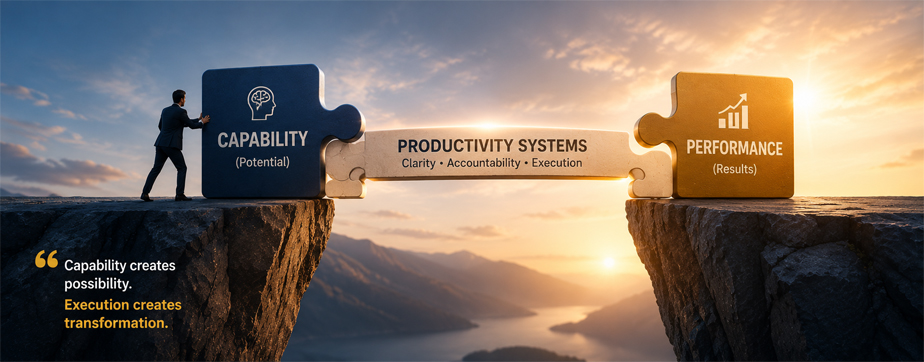
The Missing Link Between Capability and Performance
Why Organizations Invest in Talent but Fail to Convert It Into Sustainable Business Results
Executive Insight
Organizations across the world continue to invest heavily in capability building, leadership development, digital learning, and workforce training. Yet many enterprises still struggle with execution gaps, inconsistent productivity, weak accountability, and slow business outcomes. The core issue is not the absence of talent or knowledge. The real challenge lies in the inability to transform capability into disciplined execution and measurable performance. This article explores why organizations fail to bridge this gap and how integrated productivity systems can create sustainable business impact.
The Capability Paradox
Real productivity is the disciplined ability to do the right work, with the right focus, at the right time, to create the right impact.
Modern enterprises often assume that higher investments in training and certifications will automatically improve business performance. However, capability without execution discipline creates only potential — not outcomes. Many organizations have become learning-rich but execution-poor.
Why Capability Alone Fails
Employees may possess strong technical knowledge and leadership exposure, yet still struggle to deliver consistent results. This happens because performance depends not only on individual capability, but also on the organizational systems surrounding execution.
The Five Major Organizational Gaps
Most performance failures emerge from systemic weaknesses rather than employee incompetence. The most common gaps include lack of clarity, weak review systems, absence of accountability, leadership disconnect, and inefficient processes.
Capability vs Performance
Capability creates readiness, while performance creates measurable value. Capability focuses on learning and preparation; performance focuses on outcomes, execution speed, productivity, and business impact.
The Rise of Productivity Transformation Systems
High-performing organizations institutionalize execution through integrated productivity systems. These systems align people, processes, leadership, governance, and performance metrics into one unified execution architecture.
From Learning Organizations to Execution Organizations
The future belongs to organizations that can convert knowledge into action, talent into productivity, and strategy into profitability. Execution intelligence will become the defining competitive advantage of modern enterprises.
Three Pillars of Sustainable Performance
Organizations that consistently outperform others build their systems around clarity, execution discipline, and continuous improvement.
The Future of Intelligent Productivity
The next generation of enterprises will integrate AI-enabled productivity dashboards, real-time governance systems, intelligent analytics, and human-centered accountability architectures.
Enterprise Productivity Transformation Framework
- Clarity of goals, priorities, and accountability
- Structured daily, weekly, and monthly review systems
- Real-time KPI dashboards and performance visibility
- Leadership-driven coaching and execution governance
- Cross-functional alignment and decision acceleration
- Continuous improvement and productivity analytics
- Integration of people, process, technology, and culture